
What
do we know about Hungary? Wine, goulash, Czardas and paprika - I guess
that's all that will be able to transfer the average person, after
hearing such a question. However, in this series of original
"hungaricums" can truly add and embroidery.
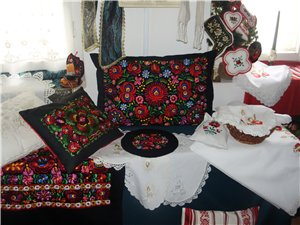
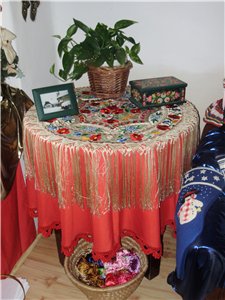
Hungarian traditional embroidery, being a peasant origin, has bright, easily recognizable and diversity. In each district Hungary have their own styles and features of the figure, for which we can calculate the origin embroiderers, however, the largest areas are only two: MATEO and kalocsai.
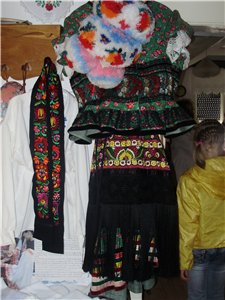
MATEO - the so-called residents Mezciema and surrounding cities tarda and Santistevan. This region is famous for its ornate national costumes, which masters shiny silk threads embroider on a black background amazing floral patterns, which gave the name to the whole direction of the Hungarian embroidery. Interestingly, rich embroidery was used for decoration of women's and children's clothes, but also men's clothing. Embroidery is a protection, a kind of talisman, allowing people MATEO to withstand hardship, falling to its share: full-time occupation of other peoples, of hunger and poverty.
Hungarian traditional embroidery, being a peasant origin, has bright, easily recognizable and diversity. In each district Hungary have their own styles and features of the figure, for which we can calculate the origin embroiderers, however, the largest areas are only two: MATEO and kalocsai.
MATEO - the so-called residents Mezciema and surrounding cities tarda and Santistevan. This region is famous for its ornate national costumes, which masters shiny silk threads embroider on a black background amazing floral patterns, which gave the name to the whole direction of the Hungarian embroidery. Interestingly, rich embroidery was used for decoration of women's and children's clothes, but also men's clothing. Embroidery is a protection, a kind of talisman, allowing people MATEO to withstand hardship, falling to its share: full-time occupation of other peoples, of hunger and poverty.
Popular
legend has it that during the Turkish yoke enemies captured a local
young man in love with a girl from the edge of Mato. Unfortunate bride
begged the Sultan to return to her beloved, that the Sultan has made a
condition to pay for the groom unusual redemption: in the middle of
winter to bring him a gift apron full of flowers. Young mistress
embroidered apron variety of garden and field flowers and presented it
to the Sultan. The Governor was amazed at her resourcefulness and being a
man of his word, he let go of her spouse needlewomen.

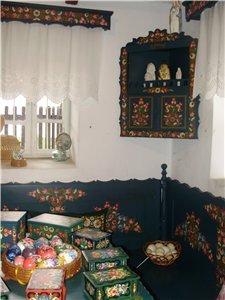
In mezőkövesd there is a Museum dedicated to the life of Mato, in which much attention is paid to the embroidery. In addition, a rich collection of drawings and designs of traditional embroidery gathered in the House-a monument of the famous masters of Borbely Molnar gáspár Martone, bearing the nickname of his grandfather, Bori Kish Janko. She was one of the inspirers of embroidery, MATEO. According she created paintings many generations of women have put into their magnificent aprons, blouses, skirts, tablecloths and linens. Today in the House-monument Bori Kish Janko is possible to get acquainted with ancient embroidery designs and also to try their hand embroidery across bust silk threads bright flower on the fabric.
Embroidery,
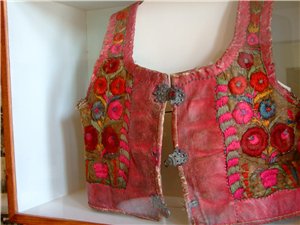
Mato easily recognized by the large rose in the center of the picture,
framed numerous small motifs, each of which has its own meaning. In
addition, special sense and color embroidery. So, yellow color means the
sun, black - force of the earth, the blue - sadness, green - mourning.
Itself embroidery is satin stitch, are used silk thread and dense cloth,
usually white or black.
Due
to isolation and solidarity of the people of Mato this style of
embroidery has remained virtually unchanged, differing from other styles
of his personality and the astounding

No comments:
Post a Comment